The pressure of the hydraulic system is generated by the extrusion of the load on the hydraulic oil, so the pressure of the hydraulic system depends on the load.
It can be known from the balance of forces, the thrust of the cylinder = load, the thrust of the cylinder = the working pressure of the hydraulic oil * the working area of the cylinder, that is, the working pressure = load/cylinder area. Therefore, the pressure of the hydraulic system depends on the size of the load force under the condition of a certain working area.
As shown in the figure below, the hydraulic oil output by the gear pump enters the system and is continuously input into the rodless cavity of the oil cylinder. If you want to lift the heavy object, you need to overcome two kinds of resistance.
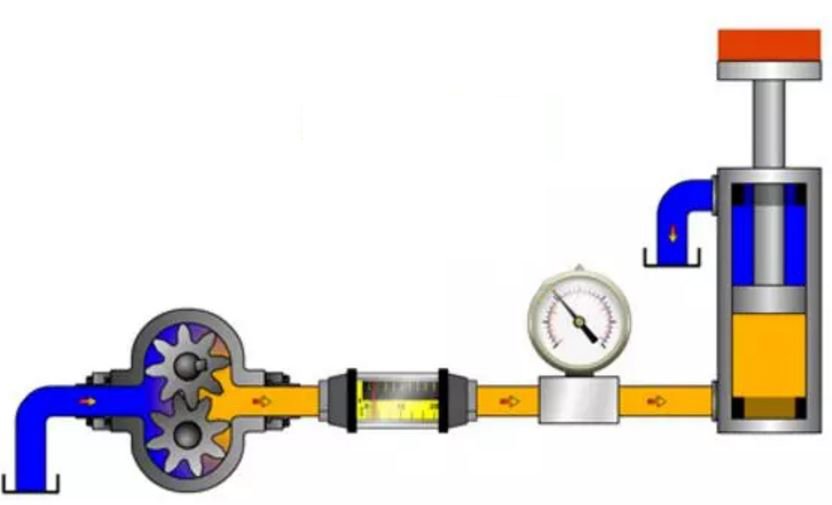
Type 1: Gravity of heavy objects
Since the piston rod is affected by heavy objects, and the oil is approximately incompressible, when the oil continuously enters the rodless cavity of the hydraulic cylinder, it must be hindered by the heavy objects, that is to say, the oil in the rodless cavity is constantly being squeezed.
Type 2: Frictional Resistance
After the hydraulic oil enters the system, it will be resisted by the pipeline and overcome the frictional resistance of the relative moving parts.
Due to the above two resistances, the hydraulic oil entering the system is continuously compressed, and the pressure is continuously increased, until the pressure of the hydraulic oil rises to the point where it can overcome the above two resistances, the gear pump still sends a certain amount of oil into the rodless cavity of the cylinder, as a result, the piston moves upward under the push of hydraulic oil to lift the heavy object.
If there is no effect of the above two resistances in the hydraulic system, it is equivalent to the oil output by the hydraulic pump flowing directly back to the oil tank, and the system cannot build up pressure.
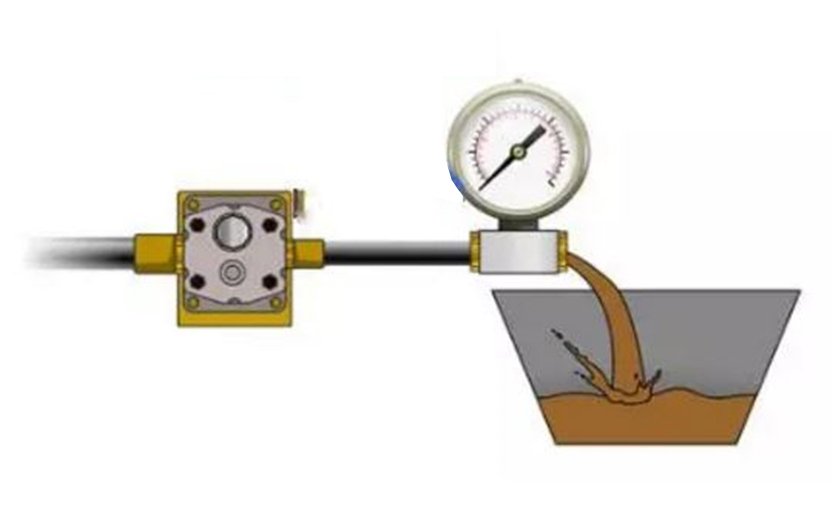
Among the above two resistances, the resistance caused by heavy objects (external load) is far greater than the resistance and friction of the pipeline along the way, so we usually say that “the working pressure of the hydraulic system is determined by the load”. The greater the load, the higher the working pressure of the hydraulic system.
How to choose the working pressure?
It depends on the load and the type of equipment. It is also necessary to consider the limitations of the assembly space of the actuator, economic conditions and component supply.
Under a certain load, if the working pressure is too low, it is necessary to increase the structural size of the actuator. For some equipment, the size is limited, and it is not economical from the perspective of material consumption;
On the contrary, if the pressure is too large, the material, sealing and manufacturing precision of the pump, cylinder, valve and other components are also very demanding, which will inevitably increase the equipment cost.
Generally speaking, for the fixed size of the equipment, the pressure can be selected to be lower, and the pressure of the heavy-duty equipment of mobile machinery should be higher.
If the working pressure is selected according to the load, the situation is as follows:
Load <5kN, working pressure <0.8~1MPa;
Load 5~10kN, working pressure 1.5~2MPa;
Load 10~20kN, working pressure 2.5~3MPa;
Load 20~30kN, working pressure 3~4MPa;
Load 30~50kN, working pressure 4~5MPa;
Load 50kN, working pressure 5Mpa.
The system working pressures commonly used by various machines are as follows:
Grinder: 0.8~2MPa
Combined machine tool: 3~5MPa
Gantry planer: 2~8MPa
Broaching: 8~10Mpa
Agricultural machinery, construction machinery, hydraulic rock drill: 10~18Mpa
Hydraulic presses, large and medium excavators, heavy machinery, lifting and transporting machinery: 20~32Mpa